
Why London Construction Projects Depend on Precision Concrete Cutting
Why London Construction Projects Depend on Precision Concrete Cutting
London never quite stands still. From the gleaming towers climbing up across Nine Elms, to those quiet yet complicated basement conversions tucked under Victorian terraces in Kensington, the capital’s construction world moves at a tempo and with a level of detail that really needs more than just brute force. When contractors need to trim, core, or push through reinforced concrete, there’s one method the industry keeps leaning on above everything else—precision drilling services London specialists provide using diamond technology.
But what is it about precision that matters so much? And why are developers, structural engineers, and principal contractors turning more and more away from anything that isn’t exact, controlled, specialist cutting on their London projects? This blog takes a closer look, and does it properly, even if the topic is a little technical.
The Complexity of London’s Built Environment
Before understanding the how , it helps a bit to appreciate the why, and London’s built environment is pretty different from anywhere else in the UK. The capital carries centuries of construction on top of one another. A simple commercial refurbishment in the City might uncover Victorian brick arches right under a 1970s reinforced concrete floor slab, and that slab is, in turn, sitting below a more recent suspended ceiling put in during a 2015 fit-out. Each layer kind of adds its own risk.
That’s exactly why precision drilling services, for London professionals are now a normal line item inside commercial project budgets, not some afterthought people mention later. If the job includes cutting cable routes through existing floor plates, carving openings for new MEP services , or creating structural penetrations for steelwork connections, the tolerance for error on London sites is basically zero.
Do it wrong, and the fallout is serious. Accidental severance of post-tensioned cables can condemn an entire floor slab, then you get delays that stretch for months. Cutting into concealed drainage or live electrical conduits inside an occupied building creates immediate safety problems. And if the works fall within a conservation area or a listed structure, irreversible harm to historic fabric can lead to enforcement action, plus meaningful financial penalties.
What “Precision” Actually Means on a Live London Site
The word precision gets thrown around a lot in construction marketing, but when you’re talking about concrete coring services and structural cutting, it actually means something much more, you know, precise. Precision is basically this, in practice:
Pre-scan verification — carried out with Ground Penetrating Radar (GPR) so you can map embedded reinforcement bars, post-tensioned tendons, hidden voids, and concealed services, before any drill bit even thinks about touching the surface.
Dimensional accuracy — core holes and cut lines done to millimetre tolerances, so the service penetrations sit where the drawings say, and mechanical installations go in first time without fiddling, rework, or awkward adjustment.
Zero collateral damage — meaning the surrounding structure, nearby finishes, and occupants are left alone, wholly unaffected by the works, noise, vibration, and airborne dust included, not “minimised” in some vague way, but genuinely controlled.
Full documentation — each stage gets recorded with method statements, risk assessments, and COSHH compliance documents, so the principal contractor’s obligations stay covered, properly, not just on good intentions.
That’s the level CA Drillers apply to every job, regardless of size. So from one 150mm core hole for a drainage opening in a residential basement, to a multi-week run of structural drilling solutions on a high-rise commercial tower, the approach doesn’t really shift, even a little.
Diamond Drilling in London: The Technical Advantage
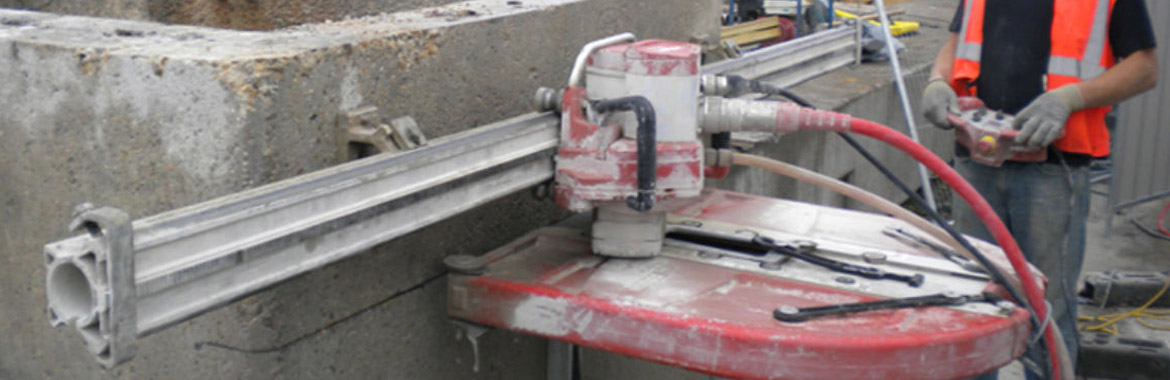
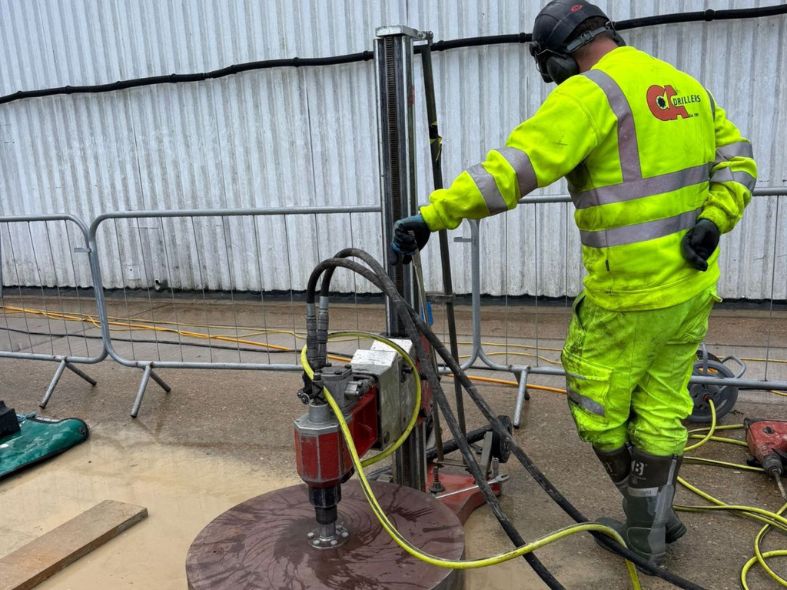
At the heart of precision concrete cutting there is diamond drilling in London, which sort of uses rotating diamond tipped core bits to create neat, exact cylindrical holes through reinforced concrete, masonry, brick, and stone. Instead of percussive methods that lean on impact energy to break up the material, diamond drilling runs on steady rotary movement together with water cooling , so the cut stays controlled and clean.
The technical advantages, compared with older approaches, are pretty noticeable:
There’s no structural vibration : Percussive breaking and traditional hammer drilling basically push vibration straight into the structure. So in places with delicate finishes, heritage fabric, or close by sensitive equipment — like a live hospital, a data centre, or even a concert venue — that vibration becomes a problem, not just a detail. With diamond drilling the vibration is extremely low, which makes it far safer to work inside occupied buildings, and it also helps reduce issues around the Party Wall, or worries from neighbouring property.
Dust suppression as standard, really : The wet cut method runs a steady stream of water to cool the bit and, at the same time, catch concrete dust before it gets airborne. That removes the silica dust exposure concern, ticks the box for Control of Substances Hazardous to Health, (COSHH) with no extra shielding or containment, and generally keeps the working area neat plus compliant. In London’s densely occupied, packed urban setting, this part matters a lot.
Consistent accuracy for any diameter : Core bits are offered from 12mm all the way to 1500mm , and even past that, and the shape of a diamond drilled opening stays perfectly round and dimensionally steady from the top to the base. So whether the spec asks for a 100mm core for a drainage outlet or a 600mm aperture for a structural column footing diamond drilling delivers.
Speed without getting stuck : Today’s diamond drilling rigs typically reach much quicker penetration rates than older style approaches, especially when you’re cutting through reinforced concrete and the rebar load is high. On schedule-critical London sites where delays can burn through thousands of pounds per day, that time advantage turns straight into commercial benefit.
Structural Drilling Solutions for Complex Projects
The most demanding applications for structural drilling solutions in London pop up where the structure itself is being tweaked, to fit new loads, new openings or even new connections. This sort of work asks for more than just skilled operatives, it also leans on some kind of collaborative relationship between the drilling contractor , the structural engineer, and the principal contractor, at the same time.
CA Drillers operate really comfortably in this kind of environment. Our project history includes work on well known schemes like Crossrail, Chelsea Barracks, the Old War Office conversion, and London City Airport , basically, the kind of projects where structural sensitivity and programme pressure are both at the highest level the industry sees. In each case , the accuracy of our drilling and concrete coring services helped the structural engineer’s original design intent , with every penetration carried out exactly where and how the drawings say it should be.
In post tensioned concrete structures, common in commercial buildings built between the 1970s and 1990s , the risk is especially high. Post tensioned tendons run through the slab in a layout that is not always clearly captured in existing drawings. Before any penetration, GPR scanning is mandatory. CA Drillers provides this scanning in-house, so there’s continuity between the survey and the drilling programme, and also it removes that awkward gap between interpretation and execution that sometimes shows up when these services are purchased separately.
Commercial Drilling Projects London: Sectors Driving Demand
The breadth of sectors driving demand for commercial drilling projects London services kind of shows how much precision cutting has turned into, really, across the entire built environment. And not in a small way. Key areas, off the top of my head, include :
Commercial office refurbishment : London’s office stock is being heavily refreshed as occupiers expect stronger energy performance, cleaner air circulation and updated MEP arrangements. Every time a new mechanical riser is fitted, every HVAC opening made, and each cable management line routed through an existing slab, well that’s coring again.
Healthcare and education : NHS trusts and academy trusts are pushing forward big capital programmes to overhaul older facilities. But working inside busy hospitals and schools means you need the near silent approach, zero-vibration, dust-controlled outcomes that diamond drilling is known for. It’s not just “nice to have”, it’s often the only practical option.
Infrastructure and transport : From London Underground station upgrades to highway drainage modifications, TfL and approved highway contractors lean on precision drilling so they can form sub-surface penetrations without upsetting operational infrastructure or nearby assets. It’s more about staying calm under pressure, basically.
Residential development and basement conversions : The continuing appetite for basement living space in central London boroughs keeps producing large volumes of concrete coring, especially for drainage lines, structural steel anchorage points and ground investigation bores. People say “basement conversion” but it’s really a stack of drilling tasks.
Retrofit and net zero upgrades : With new EPC expectations, and the whole net zero carbon push building owners are installing heat pumps, mechanical ventilation with heat recovery (MVHR), and EV charging infrastructure, and all of those need accurate openings through existing fabric, not rough breaking. Precision becomes part of the spec, not an afterthought.
Why Choosing the Right Contractor Matters More Than Ever
With London’s construction programme running basically at full capacity, and the regulatory environment getting more and more demanding by the week, the choice of drilling contractor has real commercial consequences. A contractor who cannot do GPR scanning, or who treats it as optional, introduces unnecessary risk. A team without valid CSCS cards, public liability insurance, and method statement documentation ,and yes that last one matters, puts the principal contractor’s compliance position straight under pressure. Then if a company can’t mobilise quickly enough it messes with the programme. simple.
CA Drillers address all of these worries directly. Our operatives have current CSCS certification, our management holds ISO 9001, ISO 14001 and ISO 45001 accreditations, and our fleet can be made ready for emergency same day mobilisation across all London boroughs. We also provide complete pre-works documentation as standard — not something you have to ask for — because we see programme delivery and compliance as inseparable really ,on modern London construction sites.
So when you engage CA Drillers, you’re not just hiring a general contractor who drills occasionally. You’re bringing in a specialist company, where the whole approach — from GPR scanning, equipment maintenance, operative training, through document control — is set up with one clear aim: delivering accurate, compliant, damage free concrete cutting on London’s most demanding projects.
Conclusion
Precision is not a luxury in London construction, it is a necessity, driven by the real complexity of the built environment, the ongoing tightening of regulatory requirements and yes, the commercial consequences of getting it wrong. If your project needs diamond drilling in London, concrete coring services for those service penetrations, or structural drilling solutions for intricate structural modifications, then the quality of the drilling contractor you pick will, pretty much shape the end result.
CA Drillers brings over two decades of specialist experience to every job, together with the equipment, accreditations, and in-house capabilities that London’s most demanding construction sites require.
Frequently Asked Questions
Q1. What are precision drilling services in London and when are they needed?
Precision drilling services in London refer to specialist concrete cutting and coring operations carried out using diamond-tipped equipment with GPR pre-scanning, dimensional accuracy, and full compliance documentation.
Q2. How does diamond drilling differ from standard concrete drilling?
Diamond drilling uses a rotating, water-cooled, diamond-tipped core bit rather than percussive impact.
Q3. Why is GPR scanning important before concrete coring services begin?
GPR (Ground Penetrating Radar) scanning maps embedded reinforcement bars, post-tensioned cables, voids, and concealed services before drilling commences. Without a scan, there is a real risk of severing structural tendons or live utility services — both of which can have serious safety and financial consequences.
Q4. What types of commercial drilling projects does CA Drillers undertake in London?
CA Drillers undertakes a full range of commercial drilling projects in London, including office refurbishment penetrations, healthcare and education facility upgrades, basement conversions, infrastructure works for TfL and highway authorities, retrofit installations, and large-scale structural drilling programmes.
Q5. How quickly can CA Drillers mobilise for urgent drilling works in London?
CA Drillers offers same-day emergency call-out for programme-critical situations across all London boroughs. Our fleet of drilling rigs and experienced operatives are available for rapid mobilisation, ensuring that urgent requirements do not delay the wider construction programme.
- Search
- Categories
- Blog
- Brokk demolition
- Certificate
- Concrete Cutting
- Controlled Demolition
- Core Drilling
- core drilling Kent
- Diamond Concrete Cutting
- Diamond Concrete Drilling
- Diamond Drilling
- Diamond Drilling Essex
- Diamond drilling Kent
- Diamond Drilling Surrey
- Diamond Sawing
- Fire doors
- Floor Preparation
- Hydraulic Bursting
- Kent construction drilling
- Magnetic Drilling
- Passive Fire Protection
- Stitch Drilling
- Wire Sawing Services
- Archives